Where have all the native animals gone?

September 2nd, 2010

by Editor 20100902.

Detail from The Blue Mountains Pioneers, Sydney Mail, Christmas Supplement, 1880,
Engraving in printed periodical  BN336  [State Library of New South Wales, http://www.sl.nsw.gov.au/discover_collections/history_nation/exploration/blue_mountains/index.html]


Shot one pheasant [Superb Lyrebird], with tail complete; shot two others without tail.  It appears too early in the season for them.” (William Cox crossing the Mountains in 1814).  In 1824, Rene Lesson observed lyrebirds had become less common around Springwood Military Depot “since there had been persistent hunting.”  In 1836, Charles Darwin at Hassan’s Walls commented “a few years since, the country abounded with wild animals; but now the emu is banished a long distance; and the kangaroo is becoming scarce; to both the English Greyhound is utterly destructive.”  [J. & P. Smith 1990, ‘Fauna of the Blue Mountains]

Upon first setting foot in Australia’s undisturbed ecosystems, early colonial explorers diarised observations of native animals in abundant numbers.  Then the colonialists set about their survival-fired mission to exploit and convert the unfamiliar Australian bush into a familiar replica of the pastoral landscape they had migrated from. It was a different time and culture.

As was inflicted upon so much of colonial Australia, timber getting, ring barking and land clearing cumulatively displaced many native animal populations across the settled central Blue Mountains plateau following Cox’s transit route.  “Tiger Quolls, Eastern Quolls and Dingos were all apparently common in the Blue Mountains in the 1880s and were renowned for their raids on [farmers’] poultry.”  In those early pioneering days, survival in the inhospitable bush became a fundamental preoccupation; so justifying any means to achieve it, a self-proclaimed right.  Any concept of ‘native habitat’ would have been deemed, understandably, though not excusably, a fanciful hindrance.

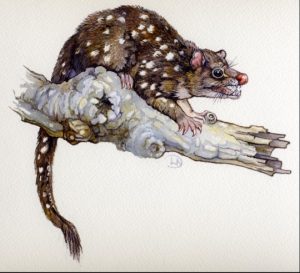
Tiger Quoll (Dasyurus maculatus)
Trapped on Pulpit Hill, Blue Mountains in 1995,
subsequently handed over to National Parks and Wildlife Service.

.

Following the rail reaching Mount Vic in 1868, hunting was touted as a main tourist attraction.  “In 1888, the advertised local game was Scrub [Swamp] Wallabies, Rock Wallabies, Wombats, Tiger Cats [Quolls], Native Cats [Eastern Quolls], Wallaroos, Platypuses, Hares, Opossums, Lyrebirds, Satin birds [Satin Bowerbirds], Cockatoos, Parrots and others.”  The popular fur trade in the 1890s saw marsupials hunted for their skins.  Hundreds of thousands of Brush tailed Rock-wallabies were slaughtered for their skins. Pelts of platypus, sugar gliders and opossums were also prized. [Smith 1990]

The early 1900s became the ultimate watershed for Blue Mountains fauna.  Most hotels in the area maintained hunting lodges for the entertainment of their guests. In January 1902, the visiting English cricket team was treated to a shoot in Kanimbla Valley, which turned out to be the ‘last great wallaby drive.’  Shooting parties from Richmond and Windsor shot at anything and everything. [Smith 1990 citing Kinghorn 1924]

That upon the arrival of the colonists, native fauna across the Blue Mountains was observed to be in such prolific numbers; provides testament to the harmonious relationship Australian indigenous people had maintained with nature over tens over tens of thousands of years.  In hindsight, we can now see how colonist land management practices over just a hundred years, directly or indirectly had decimated native fauna populations and diversity.

A further hundred years, today Australia’s ‘lucky’ first world society has advanced well beyond its initial survival needs.  Yet inherited colonial practices die hard.  Our habitual exploitative land practices perpetuate many of the same serious threats to native fauna survival. Land clearing, in all its guises, continues to destroy habitat. Foxes and feral cats have long supplanted the quolls and wild dingos of the Blue Mountains region at the top of the food chain.  Road making across the Mountains either prevents wildlife roaming or otherwise contributes to the ‘road kill’ of many native mammals and marsupials each year.  The only ‘Wildlife Crossing’ dedicated by the RTA on the Great Western Highway is on the Boddington Hill climb where a solid concrete barrier greets wildlife crossing.

If we value the return of Blue Mountains fauna, we must get serious about preserving the integrity of its habitat, exterminating feral predators and facilitating effective wildlife corridors.  Without rich dense habitat and fauna diversity, our Blue Mountains swamps, forests and heath lands, while appearing healthy and natural from vantage points like Echo Point, will incrementally become sterile ornamental gardens.

As to the feral predators, what happened to the promises in 2004 of a strategy after the Blue Mountains Urban Fox Control Programme’s public survey?  Of the survey respondents 64% confirmed foxes as an environmental problem in the Blue Mountains mainly because of their negative impact on wildlife,  53% felt that not enough is being done or more work is needed to manage foxes in the Blue Mountains, and 82% said they would support one or more ways to control foxes.    The follow up implementation (“Active Control”) component of the strategy in May 2004 at page 4 recommended to:

  • “Protect communities of threatened species in the Management Area likely to be impacted upon by foxes.  If research indicates that populations of such species are present in the Management Area a fox control programme is to be implemented.   Actions include liaising with the Blue Mountains Threatened Species Team and using best practice procedures.
  • Supplying a list of fox control contractors to residents who want to actively control foxes on their properties and investigate the servicing of community requests for assistance through an active fox control project supported by Blue Mountains City Council.
  • Respond to community calls for fox control at high-density fox sites (eg. Blaxland tip site) with the trial of a fox control project.”

With the survey done, the fox problem confirmed and the implementation actions agreed in May 2004, the programme was then stymied. Political will faltered and local council, as the land manager responsible to effect and fund the above actions, found other priorities, downplayed the problem and rustled up a defeatist line: “the damage has been done and due to the pervasive extent of fox distribution it cannot be rectified… there is no way to prevent foxes from entering the area.”   So thus, far this costly survey and committee has achieved a zero return on investment.

So where have all the native animals gone?

Toward extinction.

- – -

by Editor, 14-Jul-06.

[This article as first published in The Colong Bulletin Issue 221, May 2007, p.7,  of The Colong Foundation for Wilderness Ltd, of which the Editor was an honorary director for two years from July 2005.

This article was previously submitted for publishing in the 'Hut News' of the Blue Mountains Conservation Society [BMCS].  However, it was rejected so as not to upset the ‘relevant authorities’.  Feedback from the BMCS Management Committee was:

We have to choose our battles carefully and be realistic about what we can achieve with our limited resources. Wherever possible, we prefer to approach the relevant authorities first to see if we can work with them, before going public with our concerns. Whilst we share your concern about threats to our native wildlife, we also appreciate that the control of feral animals is a complex issue. For this reason I have decided not to publish your article in Hut News. I have no objection to re-visiting the debate over fox control in the Hut News but any articles need to be factually correct and, if they are expressing an opinion as that of the BMCS, they will need to be approved by the Management Committee.”  [ 'Hut News' Editor, Blue Mountains Conservation Society, email 24-Jul-06.]


© The Habitat Advocate    Public Domain


Australian National Wattle Day: 1st Sept.

August 31st, 2010

by Editor 20100831.

Australia’s Wattle Day Centenary (1910-2010)
is being celebrated on Wednesday 1 September 2010.

The Wattle flower is uniquely Australian.  It is a plant genus ‘Acacia‘ native to Australia.  That it is natural to Australia has made it ideal as a recognised and universally accepted Australian symbol.  The ‘Golden Wattle‘ (Acacia pycnantha) in particular is Australia’s Floral Emblem and is an integral part of the Australian Coat of Arms.

‘The first known use of wattle as a meaningful emblem in the Australian colonies dates back to the early days of Tasmania (1838), when the wearing of silver wattle sprigs was encouraged on the occasion of an anniversary celebration of the seventeenth century European discovery of the island.’      [Wattle Day Association]


Australian Coat of Arms

‘The first granting of armorial bearings to the Commonwealth of Australia was made in 1908. A new design was granted by Royal Warrant on 19 September 1912. The branches of wattle used as an ornamental accessory to the shield, representing the badges of the six States as they were in 1912, were not mentioned in the blazon, but were depicted in the coloured illustration included in the gazettal of the Australian armorial bearings. The wattle depicted has clusters of spherical flowerheads coloured yellow and blue-grey, and green phyllodes characteristic of many species of Acacia. It is not a botanically accurate representation of Acacia pycnantha ( ‘Golden Wattle’).


Order of Australia

The Order of Australia is part of the Australian system of honours and awards formally recognising achievement or meritorious service to the Australian nation.  The designs of the insignia of the Order are based on an individual ball of wattle flowers. The insignia are convex golden discs adorned with beads and radiating lines, and surmounted by an enamelled crown, signifying the traditional role of the Queen as Sovereign Head of the Order.  Blue ribbons decorated with golden wattle motifs complete the insignia in which the colours that predominate, blue and gold, represent the sea which surrounds Australia and the colour of the popularly accepted national flower. The blue and gold wreath surmounting the shield in the armorial bearings of Australia is described in the blazon, ‘for the Crest On a Wreath Or and Azure. . .’

Australians representing their country in international sporting events usually wear the national colours, green and gold, said to be based on wattle foliage and flowers.


Australian Patriotism

‘In the spirit of national and patriotic fervour generated by the approach of Federation, achieved in 1901, public interest in the Australian environment was awakened and the search for a national identity brought the desire for national symbols.

‘Archibald Campbell founded a Wattle Club in Victoria in 1899 to promote a Wattle Day demonstration every September to encourage recognition of the flower as a symbol of patriotism. In 1908 he delivered a lecture entitled ‘Wattle Time; or Yellow-haired September’ in which he stated that ‘by numbers, the Wattle is almost exclusively Australian, and should undoubtedly be our National Flower’. Interest in a national Wattle Day was revived in Sydney in 1909. Victoria and South Australia participated in 1910, and Queensland in 1912.

‘At the same time R. T. Baker, botanist and museum curator, advocated the choice of the Waratah, Telopea speciosissima as the Australian national flower. He wrote:

    “The expression ‘the land of the Waratah’, applies to Australia and no other; it is Australia’s very own. In the Wattle, Australia has not a monopoly like the Waratah, for Africa has over one hundred native wattles, and it also occurs in America, East and West Indies and the Islands. Then again it is not too much to say that throughout the whole botanical world the Waratah is probably unsurpassed as a flower for decorative purposes, and it is impossible to so conventionalise it out of recognition a great feature in a national flower.”

‘In 1911 the Evening News in South Australia reported indignant local reaction to a report ‘that South Africa has commandeered the yellow flower (wattle), and proposes to use it for patriotic purposes’ and supported the choice of the Waratah as the Australian national flower, noting its tangible features of strength, beauty and colour and its symbolic qualities of health, firmness, endurance and independence.

‘The adoption of wattle as the national flower tends to be confirmed by its introduction into the design of the Australian armorial bearings on the recommendation of the Rt Hon. Andrew Fisher, Prime Minister of Australia, when the Commonwealth Armorial Ensigns and Supporters were granted by Royal Warrant on 19 September 1912.’

The conflict which existed about the choice of the Australian national flower is seen in the inclusion of both waratah and wattle flowers as decoration on the three golden trowels used by the Governor General, Lord Denman, the Prime Minister, the Rt Hon. Andrew Fisher and the Minister for Home Affairs, the Hon. King O’Malley, for the laying of foundation stones of the commencement column in Canberra, the national capital, on 12 March 1913.
[Source:  Australian National Botanic Gardens, ^http://www.anbg.gov.au/emblems/aust.emblem.html ]


Australians in the Great War  [1914-1918]


“During World War I, various gum leaves and golden wattle were often enclosed with letters to me on service, as reminders of things they loved at home. There comes to mind the story that the arrival of one such mail caused an offensive to occur in France, with the same dried gum leaves stirring some men from the bush to burn some, to enjoy the smell of burning gum trees. One became so excited with memories, that he discharged his rifle in glee, unfortunately Fritz was not to know that and some replied with rifle fire which induced machine guns to join in and so it spread until artillery of both sides were engaged.”

Alban Pierce – Extract from a personal letter

‘Wattle Day and wattle blossom took on a new emphasis during World War I. Light-hearted celebrations and carefree gatherings were replaced by serious fundraising and a depth of patriotism never before experienced among Australians.

The New South Wales Wattle League put all its energies into helping the war effort. Together with the Red Cross and Patriotic Fund, they combined forces to raise as much money as possible by selling sprigs of wattle on the streets of Sydney. Depots were established in various parts of the city to receive wattle sent by country supporters.’

[Source:  http://wattleday.com/greatwar.php ]


National Wattle Day – why do we celebrate?

  • ‘Wattle is our national floral emblem. It is a symbol that comes directly from our land;
  • ‘Wattle is Australian and rerpesents us all. Unlike other national days, National Wattle Day excludes no one;
  • ‘Like our people, wattle has great diversity (with nearly 1.000 species) and resilience;
  • ‘Wattle welcomes in the spring and is among the first plants to regenarate after fire, reminding us of the importance of renewal as it paints our national colours across our land; and
  • ‘Wattle is a unifying symbol for all Australians. There is no other symbol that says so much about us and our land, Australia.
  • ‘Wattle is a symbol of Australia and Australians.

So join the celebration of National Wattle Day – 1 September 2010 in this, the centennial year.

Terry Fewtrell
President
Wattle Day Association

2010

[Source:  ^http://www.wattleday.asn.au/]


Victorian Bushfires 2009

‘This is the message of National Wattle Day. Wattles are usually the first pioneer plants to rise from the ashes of bushfires, using the extra nutrients to support their growth. They then provide protection for other seedlings growing underneath in a natural succession of the bush.’

‘This year we suffered the tragedy of the worst bushfires experienced in our land. Many Victorians lost their lives, their property, everything they owned. Australians all over the continent rallied to their aid, donating money and goods in an unprecedented appeal. The victims are now putting their lives back on track and planning their recovery. This resilience is a characteristic of the Australian way of life. Australians have always shown a determination to succeed and rise above any disasters, showing the spirit that has made us a great nation.’

[Source: http://wattleday.com/ ]


Golden Wattle (Acacia pycnantha Benth.)
©Mornington Peninsula Youth Enterprises
http://www.mpye.org.au/plants.htm

National Wattle Day – ‘It’s an honour’


Further Information:

Australian Government http://www.itsanhonour.gov.au/symbols/flora.cfm
Australians in The Great War 1914-1918 http://wattleday.com/greatwar.php
Wattle Day http://www.worldwidewattle.com/infogallery/symbolic/wattleday.php
Proclamation http://www.anbg.gov.au/emblems/wattle.day.gaz.html
Wattle Day Association http://www.wattleday.asn.au/about-wattle-day-1
Australian National Botanic Gardens http://www.anbg.gov.au/emblems/aust.emblem.html
Australia’s Wattle Day http://www.aph.gov.au/library/pubs/cib/1995-96/96cib1.htm
Nationalising Nature: Wattle Days in Australia http://www.api-network.com/jas/pdf/libby_robin.pdf
Wattle Day Research http://wattleday.com/research.php
Wattle Days from Adam Lindsay Gordon to Ginger Mick http://www.nla.gov.au/pub/nlanews/2007/aug07/story-1.pdf
Wattle Nationalism http://www.nla.gov.au/pub/nlanews/2008/jan08/story-1.pdf
National Symbols – Australia’s national floral emblem and national colours www.australiaday.org.au/toolkit/page173.asp
The Genus Acacia http://www.anbg.gov.au/acacia/index.html
Article: Introduction to Acacia http://plantnet.rbgsyd.nsw.gov.au/WattleWeb/intro.php
Article: The name Acacia retained for Australian species http://www.anbg.gov.au/cpbr/taxonomy/acacia-conserved-2004.html
The Acacia Page Association of Societies for Growing Australian Plants (ASGAP) http://asgap.org.au/acacia.html
World Wide Wattle – conservation, utilization and enjoyment of Australian Acacia species (Wattles) http://www.worldwidewattle.com/
Traditional uses of Australian acacias http://www.worldwidewattle.com/infogallery/utilisation/aboriginal.php
Article: If You Start Sneezing don’t Blame the Acacias http://asgap.org.au/APOL2007/jan07-s3.html
Aussie-Info http://www.aussie-info.com/identity/flora/wattle.php


© The Habitat Advocate    Public Domain

World’s Most Endangered Trees

August 28th, 2010

by Editor 20100828.

Sherwood Forest

‘Major Oak’


‘Yes, that Sherwood Forest. What was once a thick and dark mass of trees covering 100,000 acres (~20km x 20km) is now a spartan450 acres. Intense harvesting of the forest’s massive, ancient oaks for several centuries is the cause of the deforestation of this legendary woodland. Outcrops of Sherwood’s trees exist beyond the 450 acres but are not dense enough to be considered intact forest.’

[Source:  WebEcoist.com   ^http://webecoist.com/2008/09/13/20-unusual-threatened-forests-around-the-world/]


Canada’s Red Mulberry – at risk of extinction

The Red mulberry (Morus rubra) is one of Canada’s most endangered tree species and is only found in the Carolinian forest zone of southern Ontario. Red mulberry is typically an understorey species found in moist, forested habitats, including floodplains, bottomlands, sand pits and slopes. Because of its declining numbers (there are less than 200 red mulberry trees remaining in Canada) and because of the presence of several threats to its existence, the Committee on the Status of Endangered Wildlife in Canada (COSEWIC) has designated the red mulberry as “endangered” in Canada.’


[Source: Natural Resources Canada,  ^http://cfs.nrcan.gc.ca/factsheets/mulberry ]


Florida’s  Torreya Tree – most at risk on the planet!

Florida torreya (Torreya taxifolia)
©Calvin & Judy Seaman
^http://www.dfr.state.nc.us/urban/tree_detail.asp?Tree_ID=210


According to the website Hubpages.com‘ the tree the Florida Torreya (Torreya taxifolia) is the most endangered tree species in the wild in the world, and the other most at risk endangered trees around the world are:

  • African Ash
  • African cherry
  • African mahogany
  • African Teak
  • Afzella
  • Aja
  • Ajo
  • Alcerce
  • Almaciga
  • Argarwood
  • Bintangor
  • Brazilian cherry
  • Brazilian rosewood a.k.a.Dalbergia Nigra, Jacaranda da Bahia
  • Bleedwood tree
  • Ceylon satinwood
  • Egba
  • Guatemalan fir
  • Honduras mahogany
  • Ipe
  • Kauri
  • King William Pine
  • Lauan
  • Meranti
  • Molave
  • New Guinea walnut
  • Nayotah
  • Parana pine
  • Parlatorei
  • Pau rosa a.ka. Pau Brasil
  • Pencil cedar
  • Ramin
  • Red sandalwood
  • Rosewood
  • Sajo
  • Spanish cedar
  • Teak
  • Utile
  • Walnut
  • West Indian Satinwood
  • [Source:  ^http://hubpages.com/hub/Endangered-Trees ]


    UNEP Official List of Endangered Tree Species:

    According to the United Nations Environment Programme [UNEP], the world’s officially top twelve species of endangered trees are:

    African Blackwood, which is also known as Mpingo in Swahili is considered to be the national tree of Tanzania, despite the fact that it is native to 26 African countries, ranging from northern Ethiopia, to the south in Angola, also spreading from Senegal across to Tanzania.

    Mpingo not only improves soil fertility, but is also good at maintaining soil stability. Its leaves offer feed for migrating herbivores and for domestic livestock. The mature African Blackwood trees are capable of surviving fires that destroy other vegetation in grasslands. The dark heartwood of Mpingo, is one of the most economically valuable timbers in the world.

    Bois dentelle is a beautiful tree, endemic to the high cloud forest of Mauritius. Despite the fact that it has no commercial value, only two individuals are left. The most remarkable thing about the species are the flowers – sprays of white bell flowers with fine lacy petals that cover the tree in summer (January -March).

    The Clanwilliam cedar is a species endemic to the Cederberg Mountains in the Western Cape Province of South Africa. A majestic tree of 6-18 meters in height, the Clanwilliam cedar is a rot-resistant, fragrant and visually beautiful timber that was extensively exploited for building, furniture and later on telegraph poles by European settlers in the eighteenth century.

    The Dragon Tree is found on the Canary Islands, Cape Verde Islands, Madeira and Morocco. The Guanche people of the Canary Islands used the sap for mummification purposes. In Ancient Rome, Sangre de Drago (Dragon Tree) was used as a colorant and across Europe it has been used as a varnish for iron tools.

    According to the Greek myth, “The Eleventh Labor of Hercules: The Apples of the Hespérides”, the hundred-headed dragon, Landon, who was said to have been the guardian of the Garden of the Hespérides, was killed by either Hercules or Atlas in order to fulfill Hercules’ task to bring back three golden apples from the garden. As told in the myth, the trees known as ‘Dragon Trees’ sprung from Landon’s red blood, which flowed out upon the land.

    The species is classified as being “Endangered” by Cape Verde, while it is identified as being extinct in the wild on Brava and Santiago where only planted specimens exist today.


    The Honduras rosewood is found in Belize in Central America and produces timber, which is extremely valued on the world market because of its use in musical instrument production.

    Since the Honduras Rosewood supplies hard, heavy, durable and very resonant timber, when struck, it gives off a clear, loud note and making it itself most highly valued in the production of orchestral xylophones and claves. It is also used to make thin covering for fine furniture and cabinets, , knife handles etc.


    The Loulu is a palm endemic to the northernmost of the Hawaiian Islands chain with the most variety of plant species of any island in Hawaii. There are fewer than 300 individuals of the Loulu left, because of limited regeneration caused by seed predation by rats and pigs as well as competing plants.


    The Monkey Puzzle is the National Tree of Chile. Nevertheless, there is at least of these trees in every botanical garden in Europe. Its local name is Pehuén and its existence has great historical and social importance to the people living in that area known as the Pehuenche, which means “people of Pehuén”. The seeds of the tree shape an important part of their diet.

    The Monkey puzzle is also valued for its unique and natural beauty, which makes it an emblem of a national parks and provinces in both Chile and Argentina. The timber found from the Pehuén has a high mechanical resistance and moderate resistance to fungal decay, hence for its being used for beams in buildings, bridges, roofs, furniture, boat structures, thin covering etc. Monkey puzzle forests have been fast destroyed and degraded due to logging, fire and grazing.


    Nubian Dragon Tree is found in Djibouti, Saudi Arabia, Somalia, Sudan, and Uganda and was once a widespread and abundant species.

    It is one of the few species that can survive wide periods of drought in all parts of its scope, hence making it an important part of the desert ecosystem. The mature fruits of the Nubian Dragon tree are eaten and its sap and fruit may also have medicinal properties.


    Pau brasil is the national tree of Brazil, making it have strong cultural links to Brazil’s social and economic history. The species is known for the dye extract taken from the heartwood, for which it has been exploited since 1501. Presently, the dye extract and its bark are used locally for medicinal purposes. Research is being carried out to find out whether the bark of this tree can be used as a cure for cancer.

    Pau brasil wood is hard and compact, which is almost indestructible and was traditionally used to make hunting tools; commercially, it was harvested for use as a construction timber and in craftwork. It is also highly valued by musical instrument makers and still being exported for the production of bows for stringed instruments.

    The various uses acquired from the Pau Brasil have made it target to extensive collection and export of the dyewood, resulting in the loss of large areas of forest and the enslavement of local people and later on the demand for its timber by bow manufacturers has contributed to a great loss.


    Quercus hintonii, also known as Encino of Hinton (Hinton’s Oak), is endemic to Mexico. Some of the wood’s uses range from locally made tool handles, to beams and fencing poles, and primarily for firewood. Traditionally the wood is used to bake bread known as “las finas”, which the distinctive taste is brought on by the smoke.

    The species has also been highly affected by grazing, which prevents regeneration as well as the coming up of agriculture, coffee plantation and road construction have all contributed to the decline in the Quercus hintonii populations.

    “Hinton’s Oak, Quercus hintonii, is listed as Critically Endangered on the IUCN’s Red List of Threatened Species™. It is found in sub-montane to montane dry forest in Mexico. Hinton’s Oak has a restricted habitat and is thought to have strict altitudinal requirements. It has become threatened in recent years due to the serious destruction and reduction in size of its habitat.”

    [Source:  IUCN, ^http://www.iucnredlist.org/sotdfiles/quercus-hintonii.pdf


    St Helena gumwood was selected as St. Helena's national tree in 1977. The endemic floras of St Helena are not only of great biogeographical significance, but they are also home for equally rare and unusual animal species. The St. Helena gumwood is one of the fourteen most globally endangered and endemic tree species in St Helena. It is threatened by human presence and their use of the timber for firewood and building.


    The Wollemi pine belongs to the ancient Araucariaceae species, thought to be over 200 million years old. Until 1994, the Wollemi pine was believed to have become extinct about 2 million years ago, but it was rediscovered in a gorge 150 km north-west of Sydney, Australia. There are less than 100 mature trees in the wild, making it one of the rarest species in the world. Because of this rarity, the Wollemi attracts a lot of tourism, which threatens its existence because of the therefore threatened by tourism, for it may be disturbed by human activities, also exposing it to seeds being trampled, compaction of the soil, the introduction of weeds and an increase in the possibility of fires.

    Wollemi Pine (Wollemia nobilis),
    © J.Plaza RBG Sydney

    [Source:  UNEP, ^http://www.unep.org/documents.multilingual/default.asp?documentid=445&articleid=4845&l=en, accessed 28-Aug-10.]


    IUCN categorisation of tree species at risk of extinction:

    The International  Union for Conservation of Nature [^IUCN] ‘criterion A’ requires that a subject tree species has a small wild population – less than 5000 individual specimens exist in the wild on Earth.

    • A tree species will be determined to be Critically Endangered (of extinction) if there is expected to be at least 80 %  decline in 10 years or 3 generations
    • A tree species will be determined to be Endangered (of extinction) if there is expected to beat least 50 % decline in 10 years or 3 generations (Endangered)
    • A tree species will be determined to be Vulnerable (of extinction) if there is expected to beat least 20 % decline in 10 years or 3 generations.

    [Source:  ^http://www.cites.org/eng/prog/criteria/1st_meeting/trees.shtml]


    Further Information:

    [1]  Global Trees Campaign  ^ http://www.globaltrees.org/

    [2]  Fauna & Flora International ^http://www.fauna-flora.org/

    [3]  Botanical Gardens Conservation International ^http://www.bgci.org/

    [4]  Guide to Endangered Trees ^http://ran.org/content/guide-endangered-trees-0

    [5]  Trees for Life  ^http://www.treesforlife.org.uk/index.html

    [6]  Tree species evaluation using the new CITES* listing criteria ^http://www.cites.org/eng/prog/criteria/1st_meeting/trees.shtml

    [7] WebEcoist ^http://webecoist.com/2008/09/13/20-unusual-threatened-forests-around-the-world/

    [8]  BBC article ‘Sherwood Forest ‘is under threat‘,5-Oct-07, ^http://news.bbc.co.uk/2/hi/uk_news/england/nottinghamshire/7029493.stm

    [9]  1000 year old Major Oak, Sherwood Forest, Nottinghamshire, England  ^http://www.eyemead.com/majoroak.htm

    [10]  The Tree Council (UK),  ^http://www.treecouncil.org.uk/

    [11] The Tree Council (Ireland), ^http://www.treecouncil.ie/

    [12]  Treasures of the Plant Kingdom, ^http://gardenwebs.net/plant.jewels.htm

    [13] WollemiPine.com  ^http://www.wollemipine.com/index.php

    [14] Kew Gardens – Science & Conservation (England),  ^http://www.kew.org/science-conservation/index.htm

    *CITES stands for the ‘Convention on International Trade and Endangered Species of Wild Fauna and Flora


    Did You Know that?

    • ‘An area of a rainforest the size of a football field is being destroyed each second.’

    • ‘The forests of Central Africa are home to more than 8,000 different species of plants.’

    • ‘More than 5,000 things are made from trees such as houses, furniture, pencils, utensils, fences, books, newspaper, movie tickets even clothing and toothpaste.’

    • ‘Three-quarters of the world’s people rely on wood as their main source of energy.’

    • ‘In Ethiopia, between 100,000 and 200,000 hectares of forest are cut down every year. Still, at least 200 million people lack enough wood to cook their food properly.’

    • ‘Destruction of forests creates numerous environmental catastrophes, including altering local rainfall patterns, accelerating soil erosion, causing the flooding of rivers, and threatening millions of species of plants, animals and insects with extinction.’

    • ‘Tropical forests cover 23 per cent of the Earth’s land surface, but they are disappearing at a rate of 4.6 million hectares a year. Asia leads losses with 2.2 million hectares a year, Latin America and the Caribbean together lose 1.9 million and Africa loses 470,000 hectares of rain forest every year.’

    • ‘About 6.1 million hectares of moist deciduous forest disappear every year, of which the largest regional share is in Latin America and the Caribbean, with 3.2 million hectares lost.’

    • ‘More than 1.8 million hectares of dry deciduous forest disappear every year, 40 per cent of which is lost in the Sudan, Paraguay, Brazil and India.’

    • ‘Annual losses of very dry forest total some 341,000 hectares. The Sudan loses 81,000 hectares of this type of forest every year, followed closely by Botswana, with 58,000 hectares.’

    • ‘Global annual deforestation for desert forest stands at an estimated 82,000 hectares, 60 per cent of which is lost in Mexico and Pakistan.’

    • ‘Hills and mountains lose about 2.5 million hectares of forest annually, 640,000 of which are lost in Brazil, 370,000 in Mexico, and 150,000 hectares in Indonesia.’

    [Source: ^UNEP website ]


    El Árbol del Tule

    (Spanish for “the Tule Tree”) is a tree located in the church grounds in the town center of Santa María del Tule in the Mexican state of Oaxaca.  It has the stoutest trunk of any tree in the world. In 2001 it was placed on a UNESCO tentative list of World Heritage Sites.  In 2005, its trunk had a circumference of 36.2 m (119 ft), equating to a diameter of 11.62 m (38.1 ft).      [Source: http://en.wikipedia.org/wiki/Árbol_del_Tule ]

    © The Habitat Advocate    Public Domain

    VicForests’ policy of extinction

    August 26th, 2010

    by Editor 20100826.

    East Gippsland, Victoria April 2009:

    The senseless killing of a 500+ year old rare surviving Eucalyptus regnans
    by VicForest contractors in April 2009.
    ( Photo courtesy of Environment East Gippsland)

    Logging halted at iconic Bungywarr Creek (East Gippsland, Victoria, Australia)

    29 April, 2009

    ‘Today independent forests conservationists are protecting ancient forests from logging in far East Gippsland.

    “Two protestors are ‘flying’ a platform located thirty metres up in the tree canopy”, says spokesperson for the group, Ms Lauren Caulfield. “This platform is cabled off to four logging machines, immobilizing them.”

    The tree-top protestors are supported by twenty-five forests conservationists on the site.

    Bungywarr Creek was first blockaded in 1994, and has remained a contentious logging site ever since.

    “Bungywarr Creek forest was identified as iconic almost two decades ago. The old-growth that remains at Bungywarr should be included in the Brumby government’s next round of forest protection”, said Ms Caulfield.

    Earlier this month it was revealed that forests like the magnificent stands along Bungywarr Creek are sold to export woodchipping companies for less than the price of a Mars bar – a mere $2.50 per tonne.

    “Selling our valuable and carbon-rich native forests for the price of a fast food snack is not making the best financial returns to Victorians”, said Ms Caulfield.

    “For VicForests to continue to woodchip the remaining 8% of Victoria’s old-growth forests under Mr Brumby’s watch is a disgrace. Victorians expect and deserve management of our forests for a truly sustainable future.”

    “Protecting nature is one of the most important ways to fight climate change”, continued Ms Caulfield. “The forest at Bungywarr Creek will do a better job fighting climate change if it is left intact and able to suck carbon dioxide out of the atmosphere.”

    “While the Brumby government dithers on delivering the ageing 2006 old-growth forest promise, logging at Bungywarr Creek is making climate change worse”, concluded Ms Caulfield.”

    [Media Release courtesy of Environment East Gippsland]


    © The Habitat Advocate    Public Domain

    The Planet’s Critically Endangered Birds

    August 26th, 2010

    by Editor 20100826.

    Critically Endangered Birds: A Global Audit’ is a summary review by ^Birdlife International as a product of its BirdLife Preventing Extinctions Programme.  It presents the science underpinning the programme and the actions needed by other organisations, agencies and governments to complement it.

    It reports the state of the world’s Critically Endangered birds as they were in 2008, highlighting the pressures they face, and the actions needed to prevent their extinction.  The report is drawn from material developed for State of the World’s Birds, a broader report which is available for download and as an extensive searchable database at ^www.birdlife.org/sowb

    The ‘Critically Endangered Birds: A Global Audit’ report (PDF, 3.36 MB) is available by clicking the following link :

    ^Critically_Endangered_Birds_global_audit_(Birdlife_Intl_2008)


    © The Habitat Advocate    Public Domain